Governance & Stewardship · Montessori Makers Toolbox
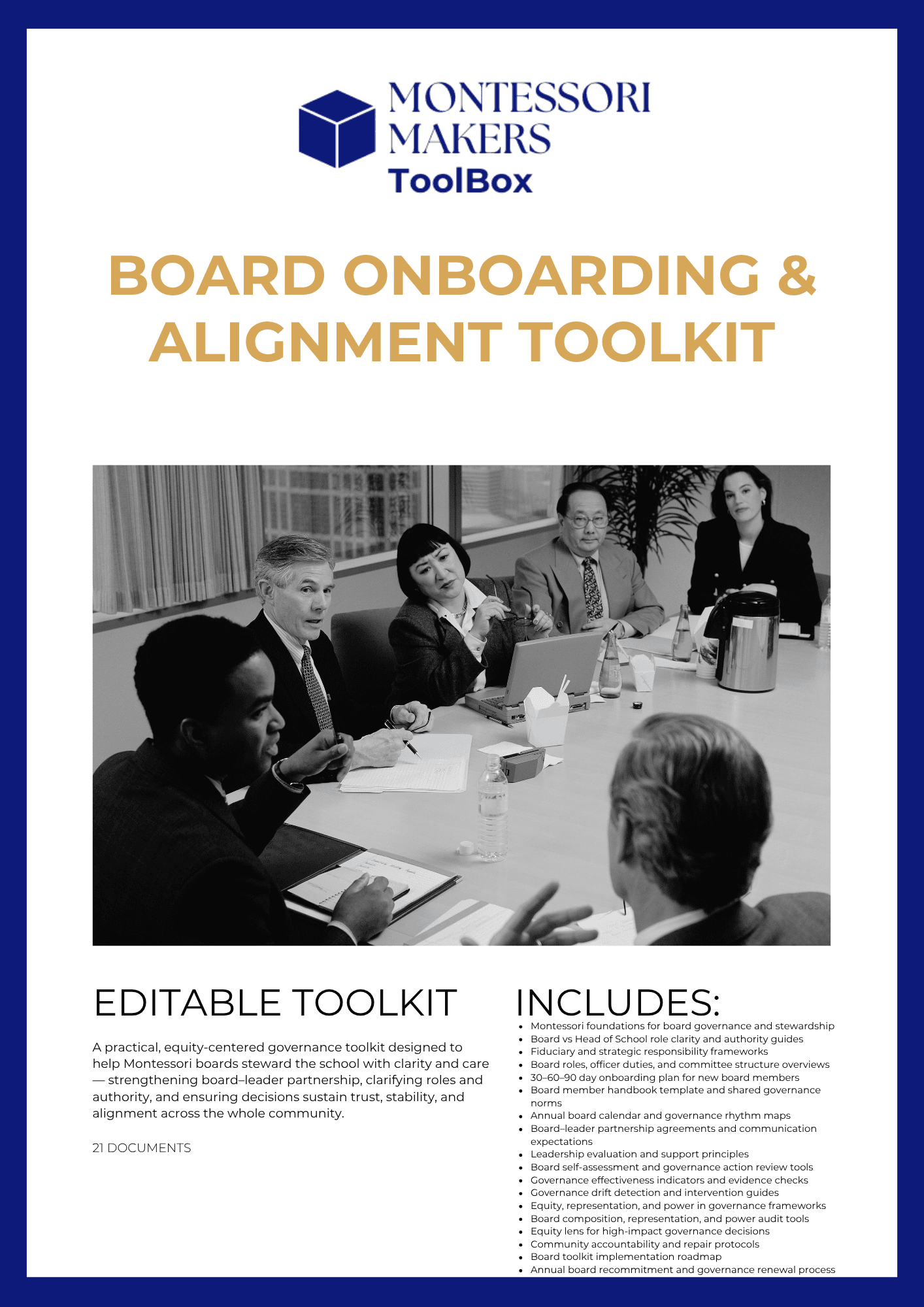
Board Onboarding & Alignment Toolkit
Build shared understanding of roles, culture, and expectations from day one.
$325
The Problem This Solves
Most board dysfunction doesn’t start with a crisis. It starts with onboarding that never happened.
New board members arrive without a shared understanding of what governance actually means in a Montessori school. They receive bylaws, a welcome email, and a seat at the table. What they don’t receive: a clear picture of their role versus the head’s role, the culture of the board they’re joining, the school’s financial position and strategic context, or the philosophical framework that makes this institution different from other schools they may have served.
The gaps created by absent onboarding compound over time. Board members default to operational involvement because governance is never clearly defined. Heads of school spend time managing board dynamics that should be productive. Committees drift. Annual giving gets confused with philanthropic strategy. And the board’s capacity to govern well — to hold the mission, support the head, and make good long-range decisions — erodes under the weight of unaddressed misalignment.
The Board Onboarding & Alignment Toolkit is a response to this structural problem. It provides the materials and processes to onboard board members well — and to align an existing board around shared understanding of governance, culture, and responsibility. It is equally useful for schools building their first onboarding program and for schools with an existing board that has never been formally aligned.
What’s Included
21 documents for board culture, onboarding, and governance alignment.
From the first orientation session through annual self-assessment, every major governance touchpoint has a structured tool to support it.
Board Orientation Program
A structured 2-session board orientation program covering Montessori governance philosophy, the head/board relationship, fiduciary responsibility, and board culture — designed to run in 90-minute sessions that can be facilitated by the head or an external facilitator.
Board Member Handbook Template
A comprehensive handbook for new board members covering governance expectations, meeting structure, communication norms, and conflict of interest policy — written to be the reference document members return to throughout their term.
Role Clarity Guide
A clear document defining the board chair, committee chair, individual member, and head of school roles — with explicit boundaries between governance and management. The single most-requested document in schools experiencing board friction.
Governance Self-Assessment
An annual board self-assessment tool for evaluating board effectiveness, meeting quality, culture, and alignment — structured to produce honest, actionable data rather than affirmative responses.
New Member Onboarding Checklist
A structured 60-day onboarding checklist for new board members covering orientation, reading, introductions, and first meeting preparation — so new members arrive ready to contribute rather than catching up.
Meeting Structure Templates (4)
Agenda templates for regular board meetings, committee meetings, executive sessions, and strategic planning sessions — each designed to focus board time on governance rather than operational reporting.
Head/Board Relationship Guide
A structured guide for clarifying and maintaining the head-board relationship — covering communication rhythms, role boundaries, and annual review structure. Reduces the most common source of governance dysfunction.
Board Culture Assessment
A diagnostic for assessing the current culture of your board — trust, communication, engagement, and alignment. Designed for use at the start of a governance improvement process or at annual retreat.
Who It’s For
Boards that want to govern well — and heads who want them to.
The Toolkit is for any school where the board is a source of energy or a source of friction — because in both cases, the alignment work matters. Strong boards get stronger with structure. Struggling boards get clarity they can work from. The investment is modest; the organizational return is substantial.
- Heads of school responsible for board development and governance
- Board chairs building board culture and member effectiveness
- Schools preparing to onboard a cohort of new board members
- Schools experiencing board dysfunction or head/board role confusion
- Governance committees responsible for board recruitment and orientation
- Schools in leadership transition where board clarity is especially critical
- Boards that have never formally examined their own effectiveness
How to Use It
Start with the Role Clarity Guide and the Head/Board Relationship Guide — these are the most frequently requested documents in schools experiencing board friction, and they produce immediate clarity regardless of where your board is currently. The Board Orientation Program is designed to run in two sessions of 90 minutes each and can be facilitated by the head of school or an external facilitator. For existing boards, the Board Culture Assessment and the Governance Self-Assessment can be used as standalone diagnostics before you introduce any structural changes.
Board Onboarding & Alignment Toolkit
$325
Give your board the foundation to govern well — from the first meeting through the most consequential decisions.
Buy Now →Related Tools
Tools that work alongside this one.
Leadership Transition & Succession Toolkit
When the board is managing a leadership transition, this toolkit provides the process structure for the search, interim period, and incoming leader onboarding.
Learn more →Leadership Operations Playbook
The board’s governance effectiveness depends partly on the operational clarity of the leadership team it oversees. The Operations Playbook builds the infrastructure the board needs to see.
Learn more →Adult Culture Framework
Board culture is adult culture. The Adult Culture Framework addresses the organizational dynamics that shape how boards communicate, trust, and make decisions together.
Learn more →For deeper organizational work, Advisory provides the strategic partnership to implement these tools alongside a broader engagement. Learn about Advisory →